Introduction
In the heavy fabrication industry, it is beneficial to move the workpiece towards the welder rather than moving the welder towards the workpiece. This is the most effective way to improve the weld quality, increase productivity and reduce operator fatigue. Welding positioners, welding manipulators and welding rotators are 3 common tools that make this step possible. Each tend to solve a different problem which is why it is important to understand their specifics before investing in them. Welding positioners, turntables and manipulators tend to move a workpiece or torch to streamline seam welding, however, their working pattern is different from one-another.
Welding Positioners
Welding positioner is a tool that grips the workpiece and rotates, tilts or performs both motions to bring each seam on a flat, horizontal position and maximize the weld quality and deposition rates. When welders struggle with out-of-position seams, these positioners are used to deliver the biggest speed and quality improvement.
- Types of Welding Positioners: Welding positioners are available in different configurations to suit different parts of geometries and production needs. The most common types of welding positioners are turning table positioners, also known as rotatory positioners, hydraulic tilt positioners, head and tail stock positioners and L-type positioners. Turning table positioners/rotatory positioners are used for rotating smaller parts, hydraulic tilt positioners are used for heavy parts that require tilting at various angles, the head and tail stock positioners are used for cylindrical workpieces and L-type positioners are used for complex parts that need full rotations and tilting from multiple axes.
- When to Choose It: The welders should choose a positioner when they operate overhead or at steep angles and orientation becomes a limitation for robots to maintain proper angle. This positioner can revolve this by re-orienting the part to flat and support high current and travel speed by significantly yielding the quality and speed gains. Two-axis positioners can handle multi-plane seams whereas single-axis units are more suitable for cylindrical geometries. Positioners are also a suitable choice for fabrication shops working with valves, pressure vessels, pipe spools, excavator buckets, etc. where welding from multiple angles is required.
Welding Manipulators
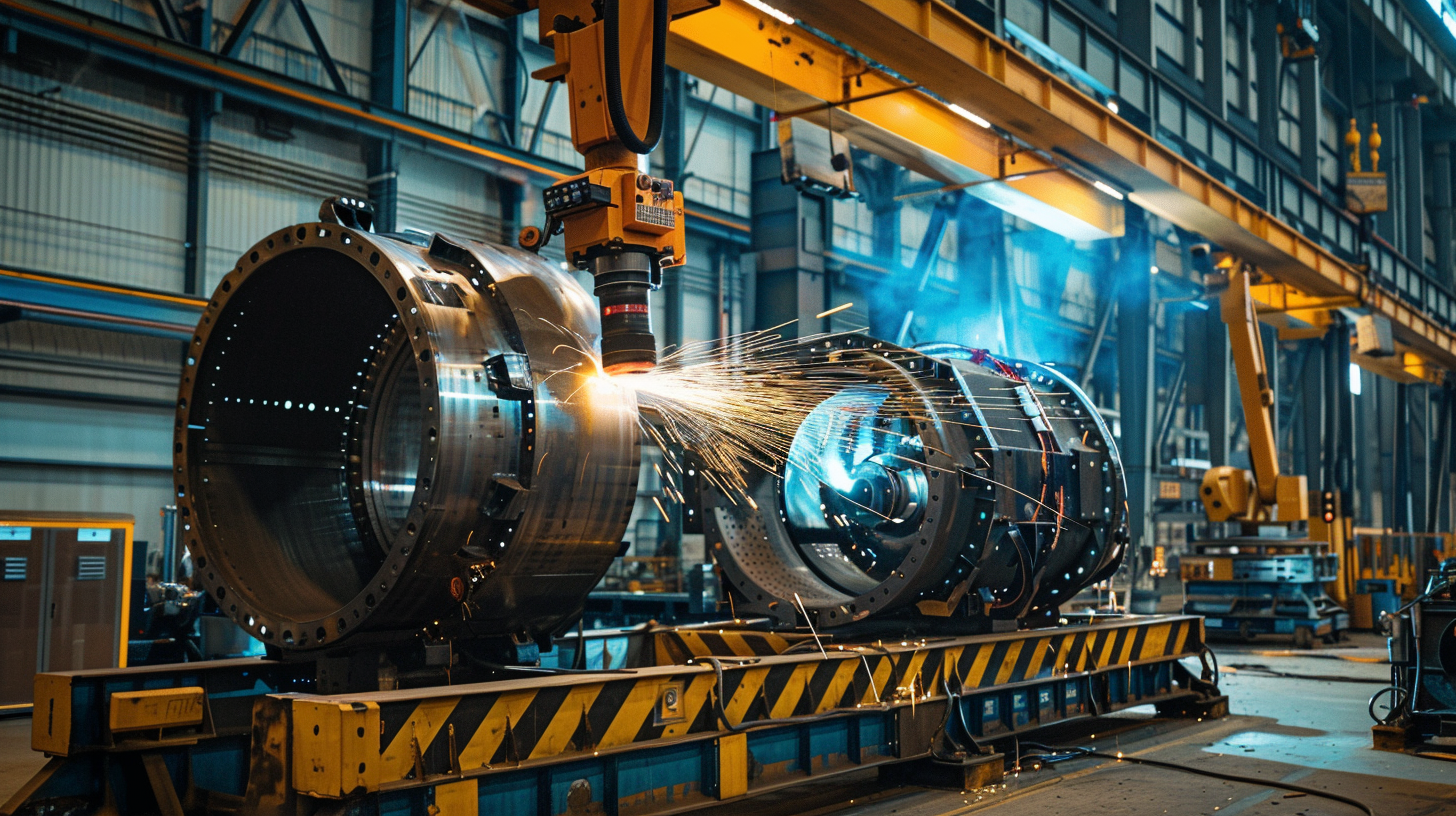
Welding manipulators are also known as column-and-boom. They tend to move the torch instead of the parts. A vertical column of these manipulators supports the horizontal boom that carries the torch or a wire feeder or flux systems in some cases over a large vessel, tank or long fabrication that cannot rotate freely. It is usually paired with a single-axis positioner to rotate the vessel beneath the boom.
- Types of Welding Manipulators: Welding manipulators are available in the range from compact models that are suitable for lighter fabrication to heavy-duty units designed for demanding applications. Its key variants include chain lift manipulators, rack and pinion lift manipulators and specialty models. These 3 types are designed for precise control and flexibility in positioning the welding torch on a wide range of part sizes and geometries.
- Applications of Welding Manipulators: Welding manipulators are suitable for large-scale fabrication tasks like wind tower sections, pressure vessels, large diameter pipes and storage tanks where consistent, high-quality weld deposition is required across long seams. These manipulators are commonly used in industries such as oil and gas, petrochemical, shipbuilding, power generation, etc. where large cylindrical structures are fabricated in high volumes.
- When to Choose It: Reach is one of the major limitations for long structures like large vessels, tanks and structures that cannot rotate freely. A manipulator is paired with a single-axis positioner and allows the torch to travel along the seam while rotating the parts under the boom. They remain standard in pressure vessel and pipe spool fabrication.
Welding Rotators
Welding rotator is a tool, designed to support and rotate cylindrical or rounded workpieces during the welding process. They constantly position and rotate the workpiece and allows the welding to be précised and even. This is a key tool in the enhancement of welding quality, minimization of operator fatigue, and enabling of continuous and uninterrupted welding runs on cylindrical structures.
- Types of Welding Rotators: There are two main types of welding rotators i.e., conventional and self-aligning. Conventional rotators have fixed wheel brackets. They are repositioned by operators to accommodate different pipes or vessel diameters on the rollers of the frames. Self-aligning rotators use a pivot or swing arm mechanism. When the workpiece is lowered onto the rollers, they automatically adjust the part correctly regardless of its diameter. These models significantly reduce setup time and are suitable for high-mix environments where different diameter parts are processed on a regular basis. Other famous types of rotators are anti-draft rotators and pipe tilting rotators. Anti-draft rotators are used to prevent axial drift of the workpiece during long circumferential welds whereas pipe tilting rotators are used to rotate pipe at a slight angle for specialized welding applications.
- When to Choose It: Rotators are a preferred choice for cylindrical workpieces like pipes, tanks, pressure vessels, boilers, wind tower sections and large diameter tubes. They are most commonly used across various sectors such as oil and gas, shipbuilding, power generation and wind energy. It is suitable for any application that involves large cylindrical fabrications and needs to be rotated continuously and precisely during the welding.
Take Away
This is the brief explanation about welding positioners, welding manipulators and welding rotators, their types and when to choose them. We hope this information will be effective for you. Please let us know through your valuable feedback and the suggestion in the drop box.