A comprehensive guide to technical welding queries and automated fabrication solutions for Aavishkar Group.
Q1: When should we switch from conventional MIG to Pulsed MIG (P-MIG) for 2mm to 4 mm aluminium sheet fabrication, and how does it prevent burn-through?
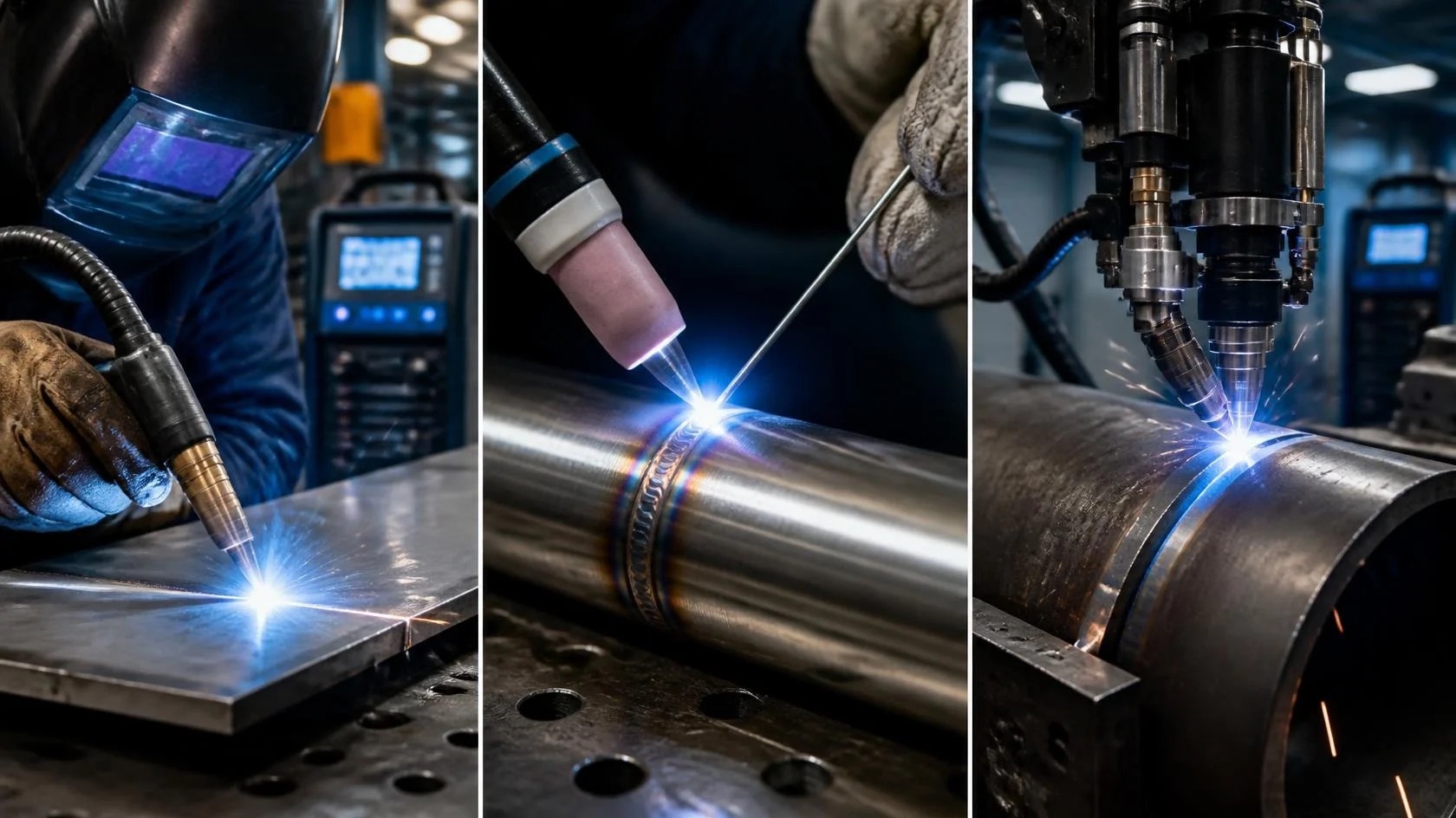
A: Switch to Pulsed MIG (P-MIG) when heat input control, spatter minimisation, and root penetration consistency become critical on thin-gauge materials (under 5 mm). Conventional spray transfer requires current levels that typically cause burn-through on thin aluminium, while short-circuit transfer produces excessive spatter and incomplete fusion. P-MIG alternates dynamically between a high peak current and a low background current. This reduces average heat input by 15% to 30% while maintaining spray transfer dynamics, resulting in minimised distortion and stable puddle control.
Q2: What is the deposition rate difference between mechanised Cold Wire TIG and Hot Wire TIG, and is the upgrade to Hot Wire justifiable for pressure vessel cladding?
A: Mechanised Cold Wire TIG typically yields deposition rates of 1.0 to 1.8 kg/hr, whereas Hot Wire TIG achieves 3.0 to 6.0 kg/hr. In Hot Wire TIG, a dedicated secondary power source preheats the filler wire just below its melting point before it enters the weld pool, increasing deposition rates by 100% to 200% and doubling travel speeds. This upgrade is highly justifiable for pressure vessel cladding as it minimises dilution rates below 10% in a single pass while drastically reducing cycle times.
Q3: We run cylindrical tank manufacturing. Should we deploy a dedicated Special Purpose Machine (SPM) or a 6-axis articulated robot for longitudinal and circumferential seam welding?
A: Deploy a dedicated Welding SPM with Column & Boom (Manipulator) and Rotators if your geometry is standardised around symmetrical cylinders. Choose a 6-axis robotic cell only if you require multi-axis contouring, complex nozzle-to-shell intersections, or high-mix component fabrication. SPMs offer 30% to 50% lower capital expenditure for large envelopes, accommodate heavy SAW/TIG payloads, and have lower operator skill barriers.
Q4: What welding parameters and purge gas setups are necessary to meet ASME BPE standards using enclosed-head Orbital TIG in pharmaceutical process piping?
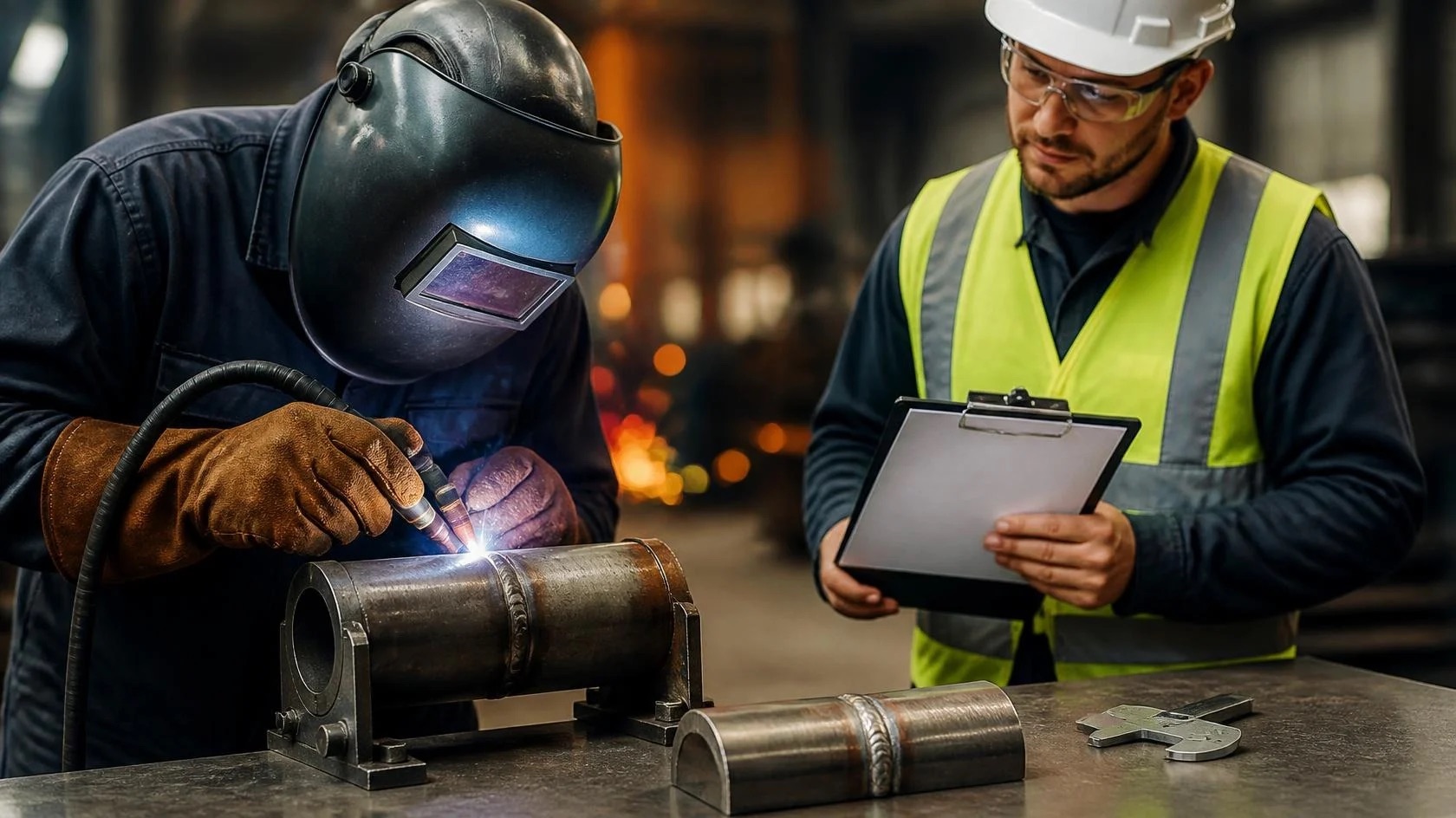
A: ASME BPE mandates full-penetration, defect-free autogenous welds with zero oxidation on inner pipe walls. This requires driving ID purge oxygen levels below 10 to 25 ppm using 99.999% high-purity Argon. You must use precise multi-level pulse parameters (1 to 10 Hz) that dynamically step down heat input as the weld head rotates to counteract puddle sag, along with a pre-ground 20 to 30-degree included angle tungsten tip to ensure arc concentration.
Q5: Why replace plasma or oxy-fuel edge preparation with mechanical plate bevellers for high-tensile structural steel?
A: Mechanical plate bevelling eliminates the Heat-Affected Zone (HAZ) and surface oxide layers inherent to thermal cutting. Thermal cutting creates a hardened martensitic edge requiring labour-intensive secondary grinding to pass non-destructive testing (NDT). Mechanical bevelling leaves base metal metallurgy unaltered, delivers root faces and bevel angles within +/- 0.5-degree tolerances, eliminates consumable gases, and allows processing speeds up to 2.0 m/min.
Q6: At what plate thickness does Submerged Arc Welding (SAW) become more economical than semi-automatic Flux-Cored Arc Welding (FCAW) for structural girder fabrication?
A: SAW becomes distinctly more economical at plate thicknesses of 20 mm and above where welds are flat (1G) or horizontal (2F) and weld seams exceed 1.5 to 2 meters in length. SAW achieves 100% deposition efficiency with zero spatter, yielding 8 to 15+ kg/hr deposition, compared to 3 to 5 kg/hr at 85% efficiency for FCAW. Its deep penetration also allows smaller included bevel angles, reducing total filler metal volume by up to 30%.
Q7: What are the exact baking and holding temperature cycles required for basic flux-coated electrodes to maintain diffusible hydrogen below H4 limits?
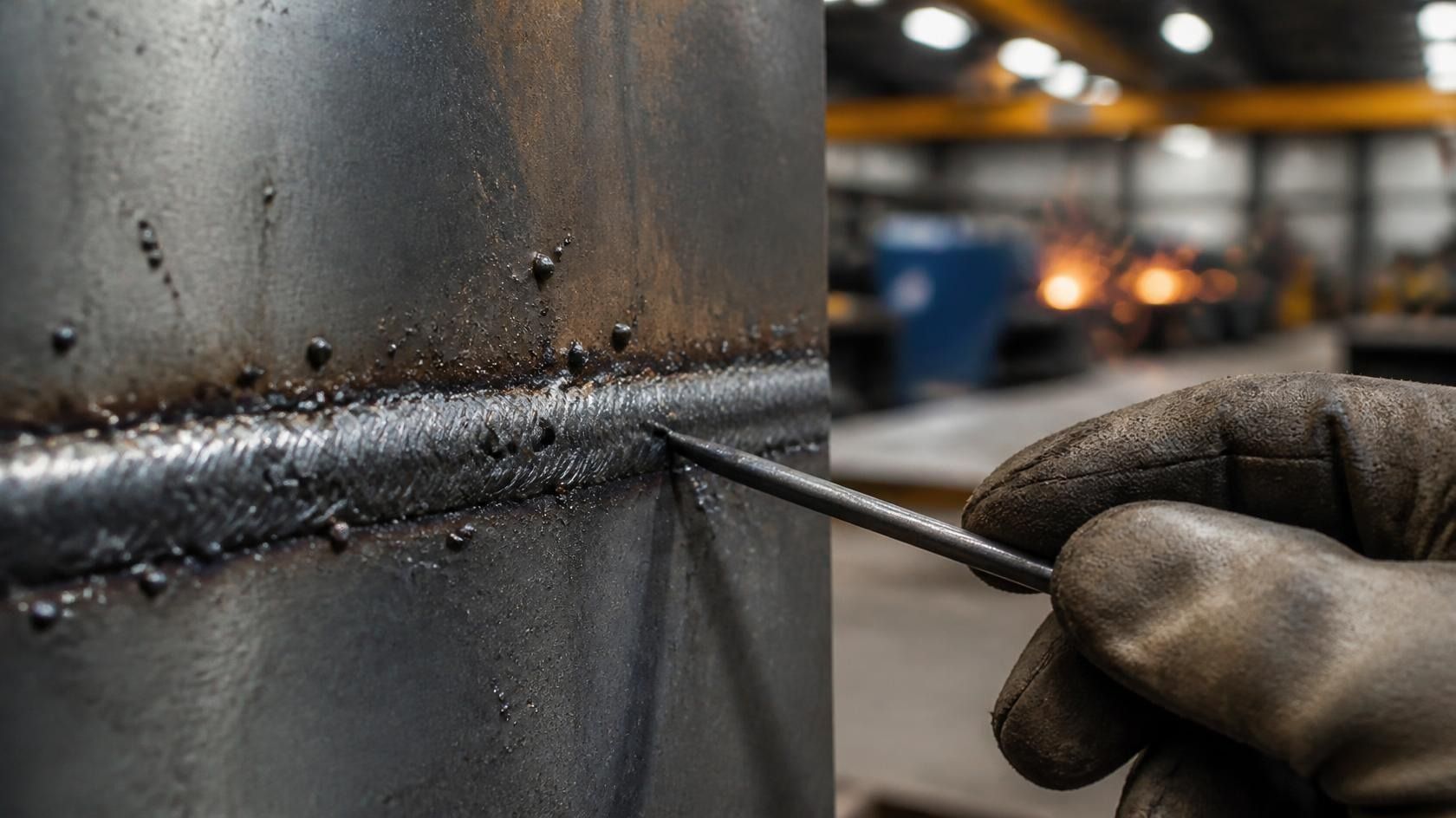
A: To maintain hydrogen levels below 4 ml/100g and prevent Hydrogen-Induced Cold Cracking (HICC), electrodes exposed to ambient humidity must be re-baked at 350 to 400 degrees Celsius for 1 to 2 hours. Once re-baked, transfer them to a secondary holding oven at 120 to 150 degrees Celsius. At the point of use on the shop floor, welders must use heated portable quivers set between 70 and 100 degrees Celsius.
Q8: Is high-vacuum on-torch extraction more effective than ambient shop-floor ventilation for capturing hexavalent chromium during stainless steel welding?
A: Yes. Source-capture or on-torch extraction captures 90% to 95% of hexavalent chromium particulates directly at the arc before they enter the welder’s breathing zone. Ambient dilution ventilation merely moves contaminated air across the shop floor. On-torch systems also require significantly lower extraction flow rates (80 to 150 cubic meters/hour) compared to the thousands of cubic meters needed for shop turnover, saving substantially on HVAC costs.
Q9: How does simulation-based training accelerate welder certification while lowering qualification overhead?
A: Simulators accelerate muscle-memory development by tracking arc length, travel speed, work angle, travel angle, and position trajectory in real time. This reduces waste of consumable wire, plate steel, and shielding gas by 40% to 60%. The system flags root causes of typical defects immediately rather than waiting for destructive testing, reducing the hands-on training hours needed to pass AWS D1.1 or ISO 9606 tests by roughly 30% to 50%.
Q10: What factors dictate whether to select an ID-mounted mandrel beveller or an OD-mounted clamshell split-frame pipe cutter for field maintenance?
A: The choice depends on radial clearance and whether pipe ends are open. ID-mounted (mandrel) tools are lightweight and best for open-ended pipe spools and single-pipe bevels, but require an open pipe end. OD-mounted clamshell tools split open to wrap around continuous pipe strings, simultaneously cutting and beveling heavy-wall pipes in situ, though they require sufficient radial clearance around the pipe exterior.