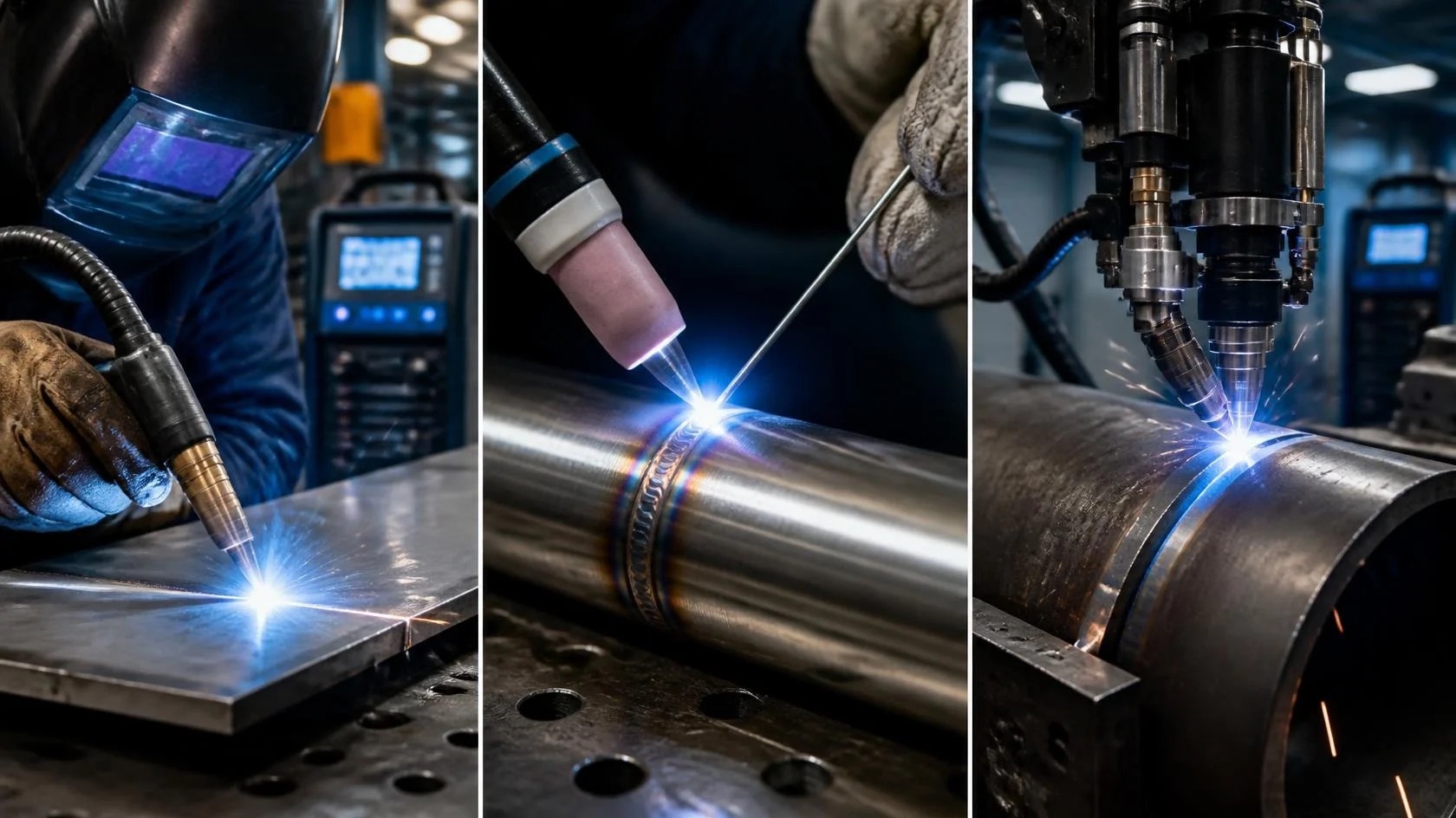
A WPS (Welding Procedure Specification) is the written instruction that tells a welder how to make a particular weld. A PQR (Procedure Qualification Record) is the record of a test weld that proves the procedure produces a sound weld. A WPQ (Welder Performance Qualification) shows that an individual welder can produce acceptable welds using a qualified procedure. In practice, the procedure is qualified first, and then each welder is qualified to weld to it.
WPS, PQR and WPQ at a Glance
| Document | Full name | What it does | Question it answers |
|---|---|---|---|
| WPS | Welding Procedure Specification | Gives the welder the approved parameters and method for a weld | How should this weld be made? |
| PQR | Procedure Qualification Record | Records the actual parameters and test results from the qualification weld | Does this procedure actually produce a sound weld? |
| WPQ | Welder Performance Qualification | Records that a specific welder passed a test within a defined range | Is this welder able to produce acceptable welds? |
A note on terminology: ASME Section IX uses WPS, PQR and WPQ. ISO standards generally use WPS together with a WPQR (welding procedure qualification record) and a welder qualification certificate. The purpose is the same, and the names differ.
Why Procedure and Welder Qualification Matter
- Many structural, pressure equipment and pipeline contracts require qualified procedures and welders as a condition of the work.
- It gives you repeatable quality, because every welder follows the same proven parameters.
- It protects you in an audit or dispute, since you can show documented evidence that the procedure was proven.
- It reduces rework, because parameters are tested rather than assumed.
Step-by-Step: How to Qualify a Welding Procedure
- Step 1 — Identify the governing code or specification. Confirm which code, client specification and material grades apply, since they determine what has to be tested.
- Step 2 — Draft a preliminary WPS (pWPS). Define the proposed process, base material, thickness range, joint design, filler metal, shielding gas, position, preheat and interpass temperature, electrical parameters and any post-weld heat treatment.
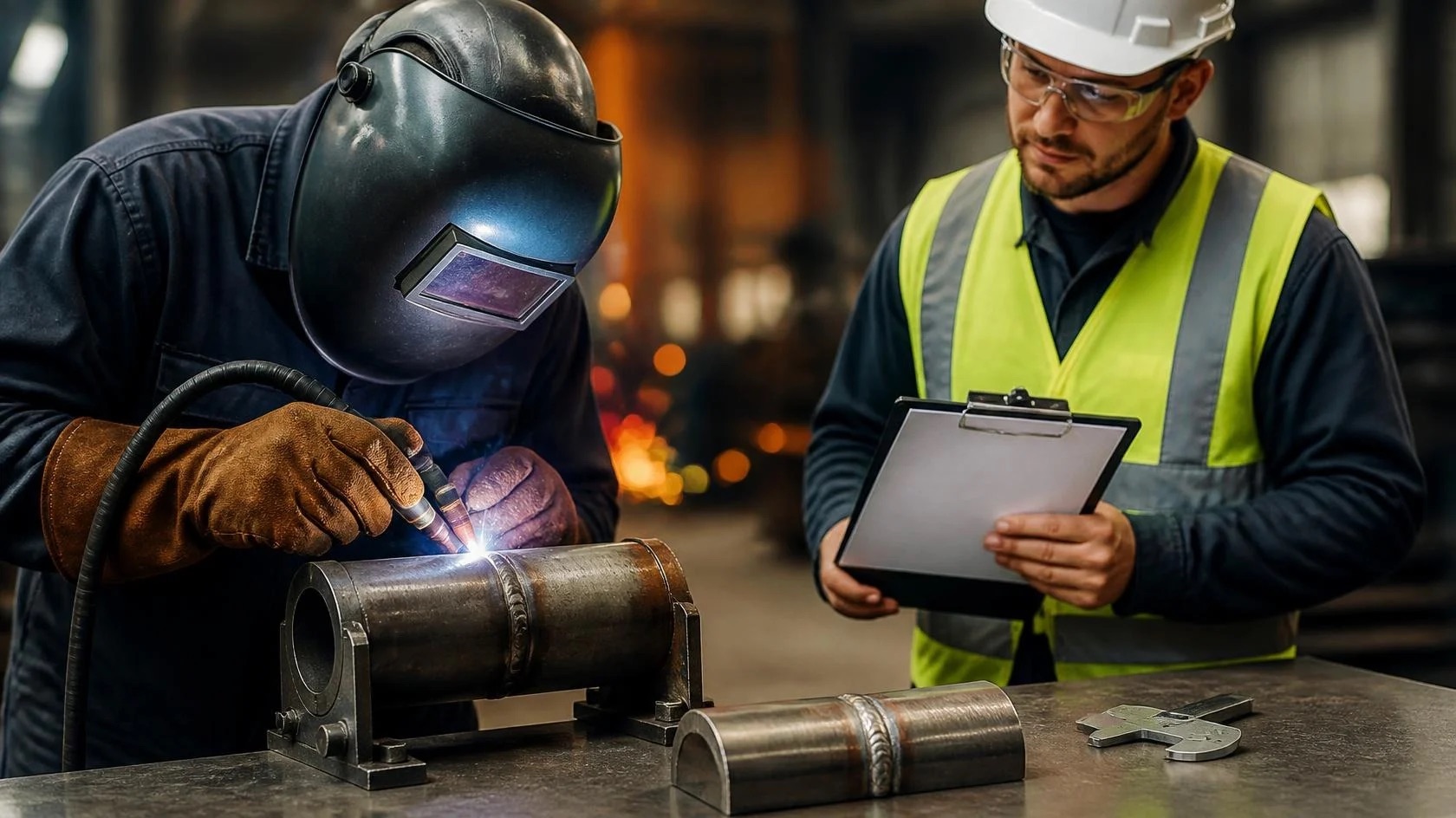
- Step 3 — Weld the test coupon. Weld a test piece under controlled, witnessed conditions, and record the actual parameters used, such as current, voltage, travel speed and heat input.
- Step 4 — Carry out visual and non-destructive examination. Inspect the test weld to the acceptance criteria in the code before cutting it up.
- Step 5 — Carry out mechanical testing. Test specimens are cut from the coupon and tested as the code requires, which commonly includes tensile and bend tests, and may include impact, hardness and macro examination.
- Step 6 — Compile and approve the PQR. If results meet the acceptance criteria, the actual welding data and test results are recorded in the PQR and signed off by the responsible person, and by the third-party inspector where one is required.
- Step 7 — Issue the final WPS. The WPS is written to cover the range of variables the PQR supports and references the PQR that qualifies it.
Step-by-Step: How to Qualify a Welder
- Step 1 — Choose the qualified WPS. The welder is tested on a procedure that has already been qualified.
- Step 2 — Weld a test piece. The test is welded under supervision, within the process, material, thickness and position the welder needs to be approved for.
- Step 3 — Examine and test the weld. The test piece is assessed by visual examination and by the volumetric or mechanical tests the code requires.
- Step 4 — Record the WPQ. The result and the qualified range are documented and signed.
- Step 5 — Maintain continuity. Most codes require evidence that the welder has continued to weld with the process within a set period, so qualification does not lapse. Check the continuity rule in your code.
Variables That Can Force Re-Qualification
Changing certain variables beyond the qualified range means the procedure may need to be requalified. Which variables count as essential depends on the code, but these are commonly affected:
- Welding process or process combination
- Base material group and thickness range
- Filler metal classification and, where relevant, flux
- Shielding gas type or composition
- Welding position and direction
- Preheat and interpass temperature
- Post-weld heat treatment
- Heat input, particularly where toughness is specified
- Joint design in some cases
What a WPS Typically Contains
- WPS number, revision and supporting PQR reference
- Welding process and the manual, semi-automatic or mechanised mode
- Base material specification, group and thickness range
- Joint design and sketch, including groove angle, root gap and backing
- Filler metal and flux classification, and size
- Shielding gas type and flow rate
- Position of welding
- Preheat and interpass temperatures
- Current type and polarity, amperage and voltage ranges, and travel speed
- Technique, such as stringer or weave, and number of passes
- Post-weld heat treatment, if any
Common Mistakes That Cause Audit Failures
- Welding outside the qualified range: using a thickness, position or material the WPS does not cover.
- No supporting PQR: a WPS that does not trace back to a qualified test.
- Consumables that do not match: substituting a filler or gas that is not covered by the procedure.
- Lapsed welder qualification: no evidence of continuity, or the qualification has expired.
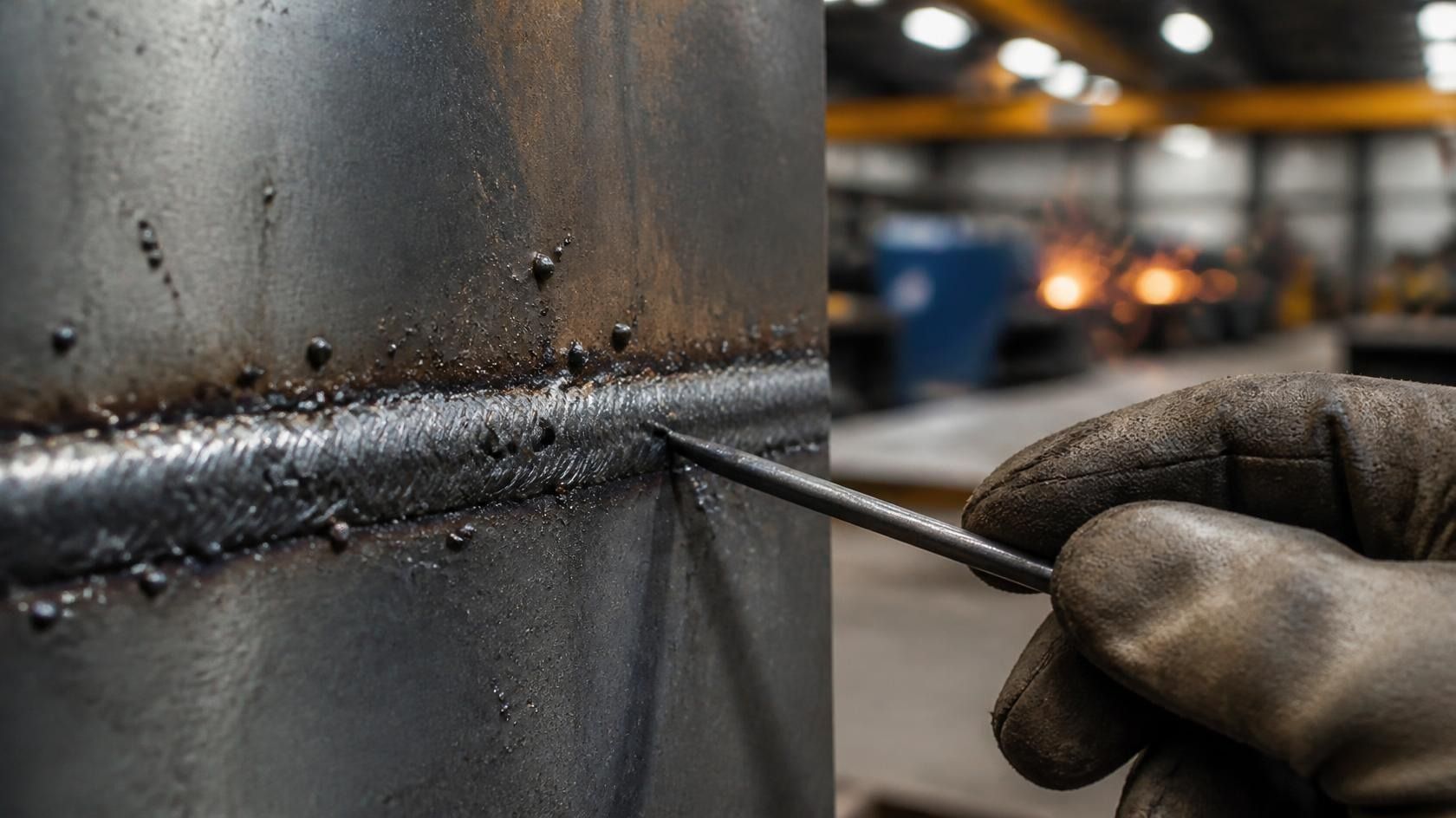
- Unrepresentative test coupons: a test that does not reflect the production joint.
- Missing signatures or witness records: required approvals or independent witnessing not documented.
- Poor records: documents that cannot be found when the client or auditor asks for them.
How Equipment and Process Control Support Qualification
A qualified procedure only helps if production welding actually follows it. Calibrated welding machines that deliver the parameters shown on the dial, properly stored and dried consumables, and repeatable setups make it far easier to stay inside the qualified range. Mechanised and automated systems can improve repeatability further, because the travel speed and parameters are controlled rather than depending only on the welder.
Frequently Asked Questions
What is the difference between a WPS and a PQR?
A WPS is the instruction given to the welder, and a PQR is the record of the test weld that proves the instruction works. The WPS is based on the PQR.
Is a WPS mandatory?
It depends on the contract and the code. Many structural, pressure equipment and pipeline codes and client specifications require qualified WPSs, so check what applies to your work.
Can one PQR support more than one WPS?
Often yes. A single qualified PQR can support multiple WPSs, as long as each WPS stays within the ranges the code allows for that PQR.
How long does a welder qualification remain valid?
This depends on the code. Many codes keep a qualification valid as long as the welder continues to use the process within a set interval, and some also require periodic re-confirmation. Check your governing code for the exact rule.
Who can witness procedure and welder qualification tests?
This depends on the code and contract. Where independent witnessing is required, a third-party inspector or certified inspection body typically witnesses and signs off the tests.
Get Help With Procedure Qualification and Inspection
Aavishkar Group provides third-party inspection and technical consultancy for fabrication companies, supporting documentation, witnessing and quality systems, alongside the welding equipment you need to hold your parameters. If you are preparing for a client audit or a new contract that requires qualified procedures, our team can help you get organised.