Introduction
All types of fabrication shops, be it small, mid-sized or large scale, face the same issues like rise in order volumes, tight delivery schedules and a shortage of skilled welders. Automation is an obvious answer to these issues. However, it is important for the fabrication shop to determine whether they should opt for cobots or a traditional industrial welding robot.
Welding Cobot
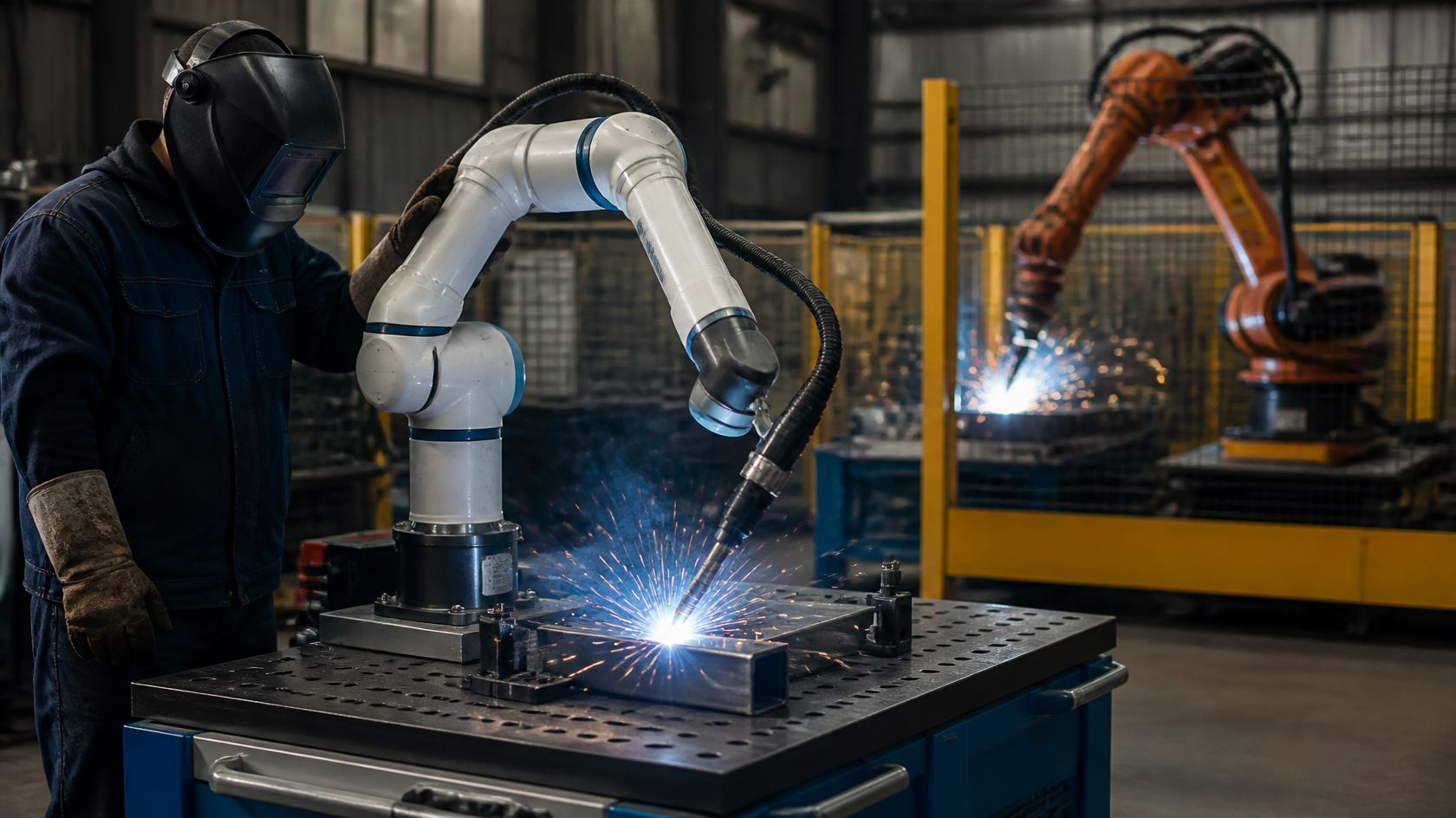
A welding cobot is a light weight robotic arm, specifically designed to work alongside people. It consists of in-built safety features like speed limits and force-sensing which allows it to stop when bumped into a person or an object. Most of the cobots can be taught by hand. The operators need to guide the torch along the joint, save the points and the cobots follow this path. It does not require any programming language and is easy to learn in a few hours or days.
When to Use Cobots
Below stated are applications where cobots can be a more suitable choice:
- For the shops that run small batches or a wide variety of parts and require frequent changeovers.
- For shops having lot sizes in tens and hundreds rather than thousands.
- When there is a shortage of skilled welders and the shop wants to expand their output rather than replace them.
- When the floor space is limited and the equipment needs to move between stations.
- When the budget is modest and the shop wants a quick, low-risk first step in automation.
Limitations of Cobot Welding
The limitation of cobots is their lower speed and duty cycle which make them a poor match for high-volume lines. Their parts still need to be fit up and fixed accurately. Complex joints, heavy plates or very large assemblies may also exceed what a cobot can reach or handle. Designs and safety features also vary between suppliers making it essential to test the system before buying.
Robotic Welding
Robotic welding uses a conventional industrial robot arm which is usually installed inside a fenced or closed cell. These robots tend to move faster, run for a longer period of time and can repeat the weld with high accuracy. They are considered ideal for high-volume production where the same part is welded thousands of times. It does require more complex programming and involves offline software or an integrator as the cells need safety fencing and sensors.
When to Use Robots
Below stated are applications where industrial robots can be a more suitable choice:
- The shop that produces large volumes of the same or very similar parts.
- For the applications where weld quality, speed and repeatability are critical to contracts.
- When the cell runs for longer periods with high arc-on time.
- When there is enough capital, space and technical support for fixturing and programming.
Limitations of Robots
The limitations of industrial robots is their high investment which goes into enclosures, safety systems, custom fixturing, and integration rather than the robot itself. Programming industrial robots is also more complex and requires a trained technician or an outside integrator, so switching to a new part can take days instead of hours. Its fenced cells are fixed to the floor and cannot be easily moved.
Key Differences Between Welding Cobots and Welding Robots
Below stated are some of the key differences between welding cobots and welding robots:
- Cost: Cobots are less costly, whereas industrial cells cost more because of enclosures, fixtures and integration.
- Programming: Cobots use hand-guided teaching, whereas robots need more technical programming.
- Speed and Duty Cycle: Industrial robots are built for continuous arc time as they are faster. Cobots are slower than robots and run at a lower duty cycle.
- Flexibility: Cobots can change over quickly between parts, whereas industrial cells can work best when parts remain.
- Safety and Space: Cobots are designed to share space with operators while robots require a fenced area.
Cost Considerations
The costs of industrial robots also include their welding power source, torch, wire feeder, fume extraction, welding table, training and installation in the final investment. On the other hand, cobots systems often cost two or three times the bare arm, once fully equipped. Thus, fabrication shops should compare complete deployed systems rather than the price of a single robot.
How to Choose Between Them
Below stated are the few questions to be asked while choosing the correct option among welding robots and welding cobots:
- How many parts does the fabrication shop weld per batch and how often do they change?
- Which process does the fabrication shop use, MIG or TIG, and what are the materials and thicknesses?
- What are the quality requirements and customer standards of the shop?
- How much space, power and ventilation does the fabrication shop have?
- Who will program and maintain the system, and how quickly can they be trained?
- Can the system scale with the fabrication shop’s needs using methods like seam tracking or added tooling?
Take Away
This is a brief explanation about welding robots, welding cobots, list of applications where they work best, their limitations, differences, cost considerations and how to choose between them. We hope this information will be effective for you. Please let us know through your valuable feedback and suggestions in the drop box.